Islamic State Exploits the US/Israel–Iran War: Incitement Propaganda, Plots, Attacks, and Elevated Threat to the West

Since the outbreak of the US/Israel–Iran war on February 28, 2026, the Islamic State (IS) has treated the conflict as both a propaganda windfall and an operational opportunity. Through a sequence of Al‑Naba editorials and a renewed tempo of inspired plotting, the group has attempted to reinsert itself into the center of global jihadist dynamics and to re-energize attacks in the Western homelands. IS‑linked attackers have again struck the U.S. homeland, with the Old Dominion University shooting standing out as the most significant successful operation since the January 1, 2025, New Orleans truck attack on Bourbon Street. At the same time, the narrative constructed around the war and Ramadan is explicitly framed as global, which heightens the threat not only to the United States but also to Europe and the broader West, where IS has a long record of exploiting external wars to incite “lone actor” and small‑cell operations. The recently disrupted plot in Spain, linked to IS branches in Somalia and the Sahel, further demonstrates that the current wave of incitement is knitting together multiple regional branches into a threat network that directly targets Europe. The IS Khurasan Province (ISKP) arrest in Italy earlier this year further indicates the continued expansion of the organization’s more multivectored external operations strategy and threat to the West.
IS Incitement Propaganda and Operational Momentum Leading Up to the Conflict
In the months leading up to the US/Israel vs Iran conflict, the Islamic State’s 2025 attack and plot campaign created a foundation for intensified calls for violence against Jews, Christians, and the wider Western public across North America, Europe, and the Pacific. From New Orleans and Bondi Beach to Villach, Berlin, Mulhouse, Bielefeld, Manchester, and disrupted conspiracies in the United States, Europe, and Turkey, the group repeatedly targeted religious holidays, memorials, markets, nightlife districts, and other soft targets, thus turning Christmas, New Year, and Jewish festivals into focal points for terror. Bondi, the Hanukkah mass shooting at Sydney’s waterfront that killed 15 and injured more than 40 on December 14, 2025, became both the apex of this wave and a springboard for renewed incitement in early 2026, as IS media and supporter channels treated it as a model for lone‑actor and small‑cell operations.
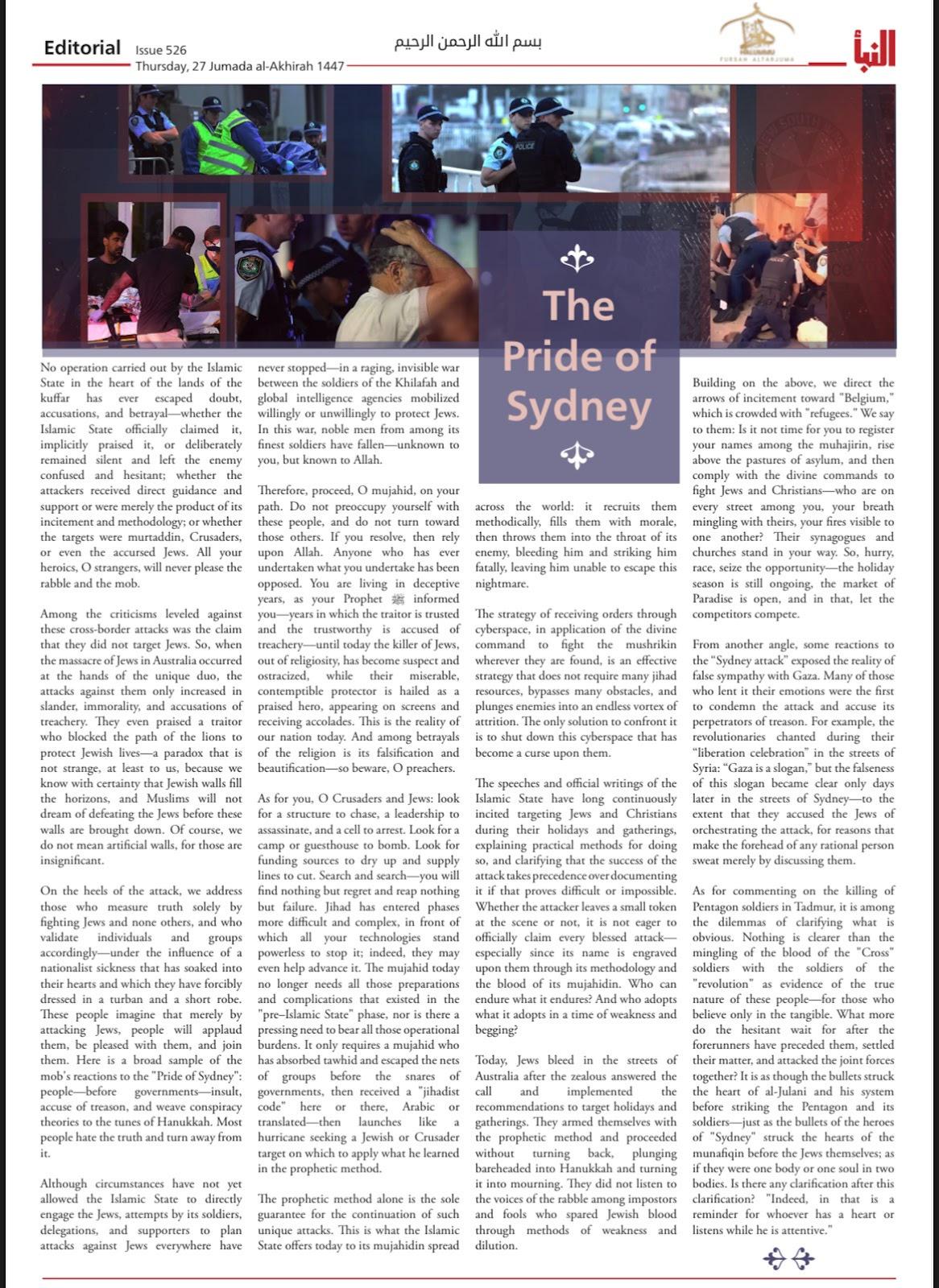
Al‑Naba quickly codified Bondi’s significance. “The Pride of Sydney” celebrated the “glorious deed of Sydney,” boasted that “the Jews are bleeding in Australia’s streets,” and urged believers who had absorbed IS’ “jihadist code” online to attack Jews and “Crusaders” at festivals and gatherings, presenting online guidance as sufficient for a single reader to “set out like the whirlwind” against synagogues, churches, and holiday crowds. A subsequent editorial, “The Season of Terrorism,” framed Christmas, New Year, and Jewish holidays as a “season of terror and anxiety” for “Crusader” societies, argued that heightened security and disrupted celebrations showed the battle had been “transferred to their homes,” and urged low‑tech violence such as vehicle rammings and attacks with heavy tools so that “there be a kill with every blow.” These texts explicitly folded Jews and Christians into a single enemy category “from Yobi to Bondi” and treated any Western crowd as legitimate blood.