

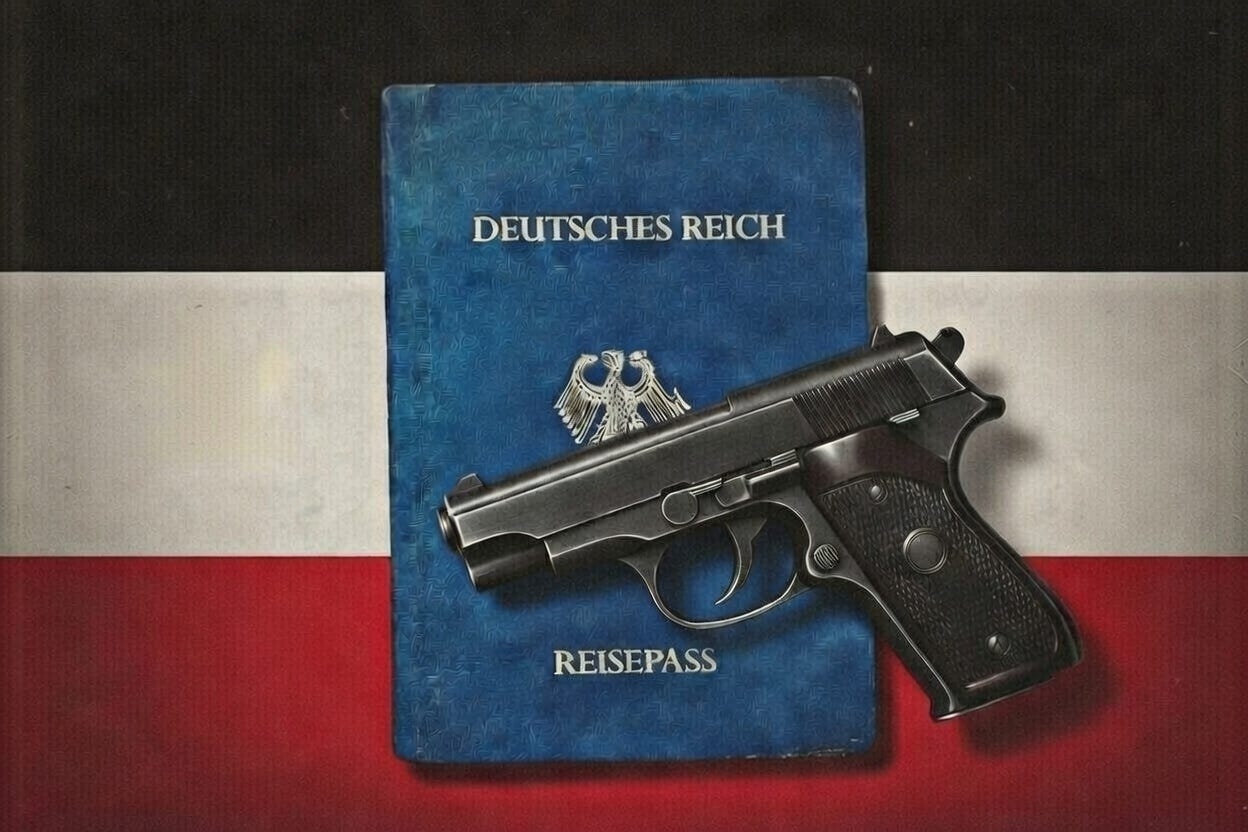
The Reichsbürger, a galaxy of German monarchists and right-wing extremists who style themselves as “citizens of the Reich,” have appeared more frequently in international news in recent years. This is due to incidents like the attempted assault on the German parliament in August 2020 and the large-scale anti-terrorism police operation against the coup-plotting group “Patriotische Union” in December 2022.
The term “Reichsbürger” describes a very heterogeneous conglomerate of groups and individuals who hold different beliefs, which are sometimes even in conflict with each other. (Some of their adherents can be thought of as similar to “sovereign citizens” in the United States.) However, all are crucially linked by the fundamental idea that the current BRD—Bundesrepublik Deutschland (German Federal Republic—is illegal or non-existent and that the former German Reich is instead still the valid and active political form of the German nation. The Reichsbürger scene is also deeply interlinked with the so-called Selbstverwalter (self-government individuals—again, taking us back to our sovereign citizen-types). Security authorities heavily monitor the Reichsbürger movement primarily because some of its members have access to weapons, and most if not all are heavily influenced by extremist ideology. Although the government and police have dismantled nonviolent Reichsbürger groups, the threat of violence remains the key concern. This was demonstrated in 2016 when a Reichsbürger killed a police officer for the first time.
The political and ideological constellation of the Reichsbürger and Selbstverwalter is complex to analyze due to its granularity, but several of its structural elements and tendencies can be explored in depth.

The Ideologies of the Reichsbürger and Selbstverwalter
The Reichsbürger and Selbstverwalter milieu contains a wide range of positions, beliefs and ideologies. The scene began to develop substantially in the 1980s, incorporating political instances ranging from anti-democratic Second Reich monarchism to spontaneous right-wing libertarianism, from ethnonationalist ultra-racism to Third Reich Nazi-nostalgia. The core ideological belief is that the BRD - Bundesrepublik Deutschland is not sovereign and never was, and that the German Reich still exists, usually within the 1871 or 1937 borders. A fundamental conspiracy theory is that the BRD was not established as a national state but rather as a private company (a German GmbH) that simply continues to administer the country under the Allies’ ongoing post–World War II occupation. Accordingly, the current German Basic Law is rejected and the laws of the BRD are considered “general terms and conditions” that can be accepted or refused by individual citizens. All of these perspectives are based on a deep, extreme and absolute distrust of the German liberal-democratic state and its bureaucratic representatives. This framework produces a variety of political stances, including a strong push toward internal separatism, which aims to establish parallel, self-isolated state structures. Examples are the so-called “Exilregierungen” (“governments from exile”) or the “KRR - Kommissarische Reichsregierungen”, self-declared provisional Reich governments with their own “ministers” and “chancellors”. These entities, which can be quite surreal, are created by Reichsbürger groups that often compete with each other and all claim to be entitled to renegotiate the status of the German Reich with the current governments of the countries that won World War II. These anti-state and anti-government positions are clearly and deeply reactionary and far distant from any anti-state project elsewhere along the libertarian spectrum, since the current German state is usually set to be replaced by a more authoritarian one.
