
Sarayah Ansar al-Sunnah: Sectarian Violence, Micro-Insurgency, and the Islamic State’s Shadow in Syria

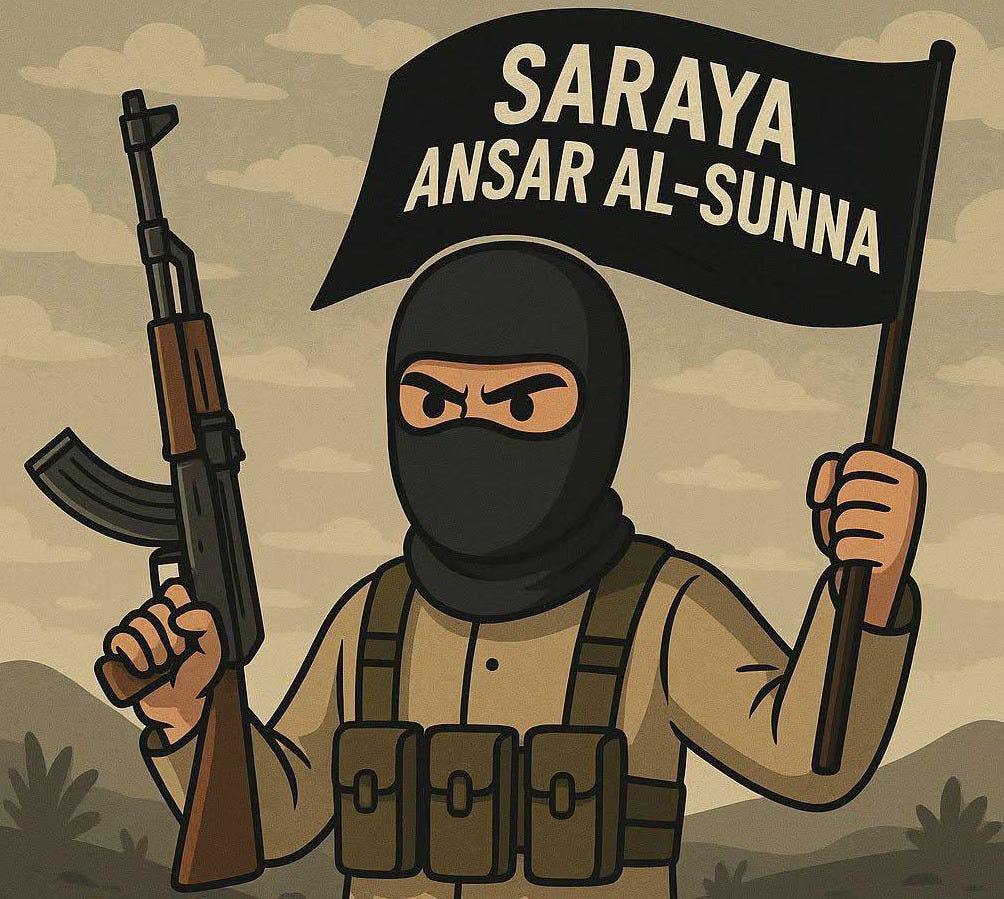
In the spaces left uncovered by the collapse of the Syrian state order and the post-Assad political transition, jihadist violence has not disappeared: it has fragmented, adapted, and sectarianized. In this fluid and volatile context, Sarayah Ansar al-Sunnah, a Sunni militant group, represents one of the most emblematic examples of how ideologically rigid yet operationally light micro-insurrections can exert a disproportionate impact on local security and social cohesion.
While remaining a numerically limited player, Sarayah Ansar al-Sunnah has demonstrated a growing ability to combine targeted sectarian violence, structured propaganda, and takfir religious narratives functional to the radicalization and intimidation of minorities. Recent attacks against the Alawite community in Homs, accompanied by a coordinated and stylistically refined communication campaign, confirm that the group does not operate episodically, but according to a coherent logic of symbolic and sectarian escalation. The analytical importance of Sarayah Ansar al-Sunnah lies not so much in its military capabilities, but in its ideological and functional positioning within the Syrian jihadist ecosystem. The group is, in fact, placed in a grey area: formally independent but increasingly aligned, at the doctrinal, communicative, and operational levels, with the Islamic State’s models and vision. This “shadow” does not necessarily imply direct command or organizational fusion but rather suggests strategic convergence that warrants attention.
Developments observed between January and April 2026 confirm the persistence of these patterns, with no evidence of a shift toward higher-intensity operations but continued reliance on targeted sectarian violence and narrative amplification.
Analyzing Sarayah Ansar al-Sunnah, therefore, highlights the evolving nature of Syrian jihadism: less territorial, more cellular, less control-focused, and more sectarian destabilization — underscoring the need for the audience to stay alert to these shifts.
History, Genesis, and Operational Development: From the Birth to the Centrality of Homs
Sarayah Ansar al-Sunnah emerged publicly in early 2025. Still, its appearance was not a sudden event, but rather the result of an underground radicalization process that had matured over the final years of the Syrian conflict. The group was born in a context marked by the disillusionment of more intransigent jihadist sectors with the political and military pragmatism adopted by the de facto authorities in northwestern Syria. In particular, the post-Assad transition and the progressive institutionalization of power have created a fertile space for actors who reject any compromise and demand a purely punitive and sectarian reading of jihad.
From the earliest claims, Sarayah Ansar al-Sunnah presents itself as a decentralized clandestine network, lacking defined territorial control but capable of operating continuously through autonomous cells. This structural choice is not accidental: it allows the group to survive in a highly repressive environment, reducing exposure to counterterrorism operations and making it more difficult to attribute and neutralize its operational capabilities. The rhetoric adopted from the beginning is unequivocal: the group defines itself as an instrument of “justice” against apostates, religious minorities, and alleged collaborators of the old state apparatus. Operationally, the first phase of Sarayah Ansar al-Sunnah’s activity is characterized by low-intensity, high-frequency attacks, predominantly in rural and peripheral areas of Hama, Latakia, and Homs. These involve targeted assassinations, seizures, arson, and acts of intimidation against civilians belonging to Alawite communities and, to a lesser extent, against former members of the security forces.
These operations have a dual function: on the one hand, they consolidate the group’s reputation as a determined sectarian actor; on the other hand, they fuel a narrative of impunity and moral control over the territory, even in the absence of a visible and stable armed presence. As the months pass, Sarayah Ansar al-Sunnah shows a progressive qualitative evolution. The use of improvised explosive devices, initially sporadic, becomes more structured, signaling an accumulation of technical expertise and better logistical organization. In parallel, the group expands its scope of action, demonstrating the ability to strike even in urban settings and in areas formally under government control. This operational leap is accompanied by a growing sophistication of its propaganda, which begins to follow narrative and graphic patterns attributable to the transnational jihadist ecosystem. Within this framework, Homs takes a central role in the group’s strategy. The city and its province represent an ideal environment: a geographical crossroads, an area historically marked by sectarian fractures and, above all, a space characterized by large grey security zones. It is therefore not surprising that Homs has become the main theatre of Sarayah Ansar al-Sunnah’s most significant operations, culminating in the most recent attacks against Alawite targets. In particular, the December 2025 attack by the group represents a turning point. The use of an explosive device within an Alawite place of worship, the immediate claim, and the subsequent multi-layered communication campaign indicate full operational and narrative maturity. The group doesn’t just strike, it constructs a story, pre-emptively defends its religious legitimacy, and places it within a framework of future threat. The violence is not presented as an isolated event, but as part of a campaign destined to intensify.
Taken together, the evolution of Sarayah Ansar al-Sunnah shows the typical trajectory of a contemporary jihadist micro-insurgency: emergence in dissident environments, consolidation through targeted sectarian violence, progressive technical and communicative sophistication, and concentration of operations in symbolically and strategically relevant areas. Homs is not just an operational target, but the laboratory through which the group attempts to demonstrate its relevance and project itself as a credible jihadist actor in the new Syrian landscape.
Recent monitoring in early 2026 indicates that central Syria, particularly Homs and adjacent areas, remains the primary operational environment, with activity characterized by intermittent, recurrent low-signature attacks.
Propaganda and strategic communication
In the case of Sarayah Ansar al-Sunnah, propaganda is not just an accessory but a core element that enhances its operational reach, and emphasizing the importance of the audience monitoring its narrative strategies closely.
Telegram represents the central axis of this ecosystem. The group has gradually abandoned a fragmented, opportunistic dissemination of content to stabilize itself on a network of official and semi-official channels, each with a distinct function: operational demand, ideological dissemination, and doctrinal consolidation. This segmentation allows the group to target different audiences — militants, sympathizers, and external observers — without overlapping communication levels. Stylistically, Sarayah Ansar al-Sunnah’s propaganda shows a clear evolution. The first communiques were essential, sometimes rudimentary. As the months passed, however, the group adopted standardized visual formats, detailed infographics, maps, casualty counts, and structured post-attack narratives. The goal is not only to inform but also to impose an interpretative framework for the event: define the target, justify action, neutralize criticism in advance, and project future threats. The deliberate use of sectarian language as a political tool is particularly relevant. The constant semantic redefinition of objectives, for example, the denial of the “Islamic” nature of the affected Alawite places of worship, is not accidental, but part of a defensive and offensive communication strategy at the same time. Defensive, because it aims to shield the group from accusations of excess or deviation; offensive, because it normalizes violence against specific communities, transforming it into a legitimate religious act. Propaganda is not limited to claims. A recurring element is the publication of names, photographs, and accusations against alleged collaborators of the old regime or members of minorities, creating a sort of “digital proscription list.” This approach has a strong, intimidating effect. It suggests that Sarayah Ansar al-Sunnah also serves as a platform for incitement and indirect coordination, rather than as a rigidly centralized organization.
In short, the group’s strategic communication aims not so much to claim control of the territory, but to control the narrative. It is in this symbolic space that Sarayah Ansar al-Sunnah attempts to compensate for its limited military capacity, presenting itself as a coherent, ideologically pure, and inevitable actor.
Ties and convergences with the Islamic State
The relationship between Sarayah Ansar al-Sunnah and the Islamic State cannot be read in the classical terms of formal affiliation. There is, at present, no public evidence of a direct command, official bay’a, or organizational merger. However, limiting this observation would mean losing sight of the most relevant dynamic: functional and ideological convergence.
On a doctrinal level, the affinities are evident. The vision of takfir, the rejection of any political authority not based on a radical interpretation of Sharia law, and the centrality of sectarian violence as a tool for social purification are elements that fully overlap with the ideological matrix of the Islamic State. Sarayah Ansar al-Sunnah does not simply share these principles: it explicitly reaffirms them in its own texts and religious production.
Even more significant is the convergence at the communicative and organizational levels. The adoption of propaganda models within the Islamic State’s media ecosystem, from the structure of infographics to the language of claims, suggests not only imitation but also recognition of a canon. In jihadist circles, this type of imitation is not neutral: it signals belonging to a very specific tradition and worldview. The same applies to the operational organization. The autonomous cell structure, the emphasis on small groups, the rhetoric of “lone wolves”, and the ability to strike without a visible chain of command mirror models already tested by the Islamic State in Syria in recent years. Sarayah Ansar al-Sunnah appears to move along the same route, adapting it to a smaller scale and a more fragmented context. Particularly indicative is the group’s ambiguous posture towards the Islamic State. The statements in which Sarayah Ansar al-Sunnah states that it is not currently cooperating with IS, while explicitly leaving open the possibility of doing so in the future, are not simple rhetorical formulas. These are calibrated messages - intended for a wider audience: they reassure about formal autonomy but signal ideological compatibility and strategic availability.
In terms of intelligence, this positioning makes Sarayah Ansar al-Sunnah a potential convergence asset. In a scenario of strengthening the Islamic State or further deteriorating security in central Syria, groups like SAS could act as local multipliers, facilitating recruitment, logistics, and social penetration without the need for direct deployment of IS cadres.
In conclusion, the relationship between Sarayah Ansar al-Sunnah and the Islamic State should not be read as a hierarchical relationship, but as a relationship of shadow and reflection. SAS operates in the space vacated by IS, takes up its languages and models, and helps keep alive a jihadist ecosystem that, although fragmented, remains deeply interconnected. No new evidence as of May 2026 indicates formal affiliation with the Islamic State, although ideological and operational convergence remains consistent.
Conclusion: Patterns, Threat Assessment, and Intelligence Outlook. Why Sarayah Ansar al-Sunnah Matters
Sarayah Ansar al-Sunnah’s overall analysis clearly shows that the group cannot be reduced to a mere acronym or to an ephemeral phenomenon linked to the volatility of the post-Assad period. In contrast, Sarayah Ansar al-Sunnah embodies a mature form of jihadist micro-insurgency, designed to operate persistently in an environment characterized by political fragmentation, security vacuums, and unresolved sectarian rifts. The group’s operating patterns are consistent and repetitive. Sarayah Ansar al-Sunnah favors attacks with low tactical complexity but high symbolic value, focusing on carefully selected sectarian targets. The areas of operation, particularly Homs and central Syria, are not random, but respond to a precise geographical and political logic: transition zones, with discontinuous state control, crisscrossed by communal tensions and historically used by jihadist networks as spaces for maneuver and refuge. Another recurring element is the absence of indiscriminate military escalation. The group avoids operations that would require prolonged exposure or a heavy logistical structure, preferring to strike and dissolve quickly. This choice reflects an operational rationality, not a weakness: Sarayah Ansar al-Sunnah does not aim at territorial control, but at the normalization of sectarian violence as a political tool. In this sense, every attack is conceived as a message, rather than a military action in the strict sense.
From a threat perspective, the group does not, at present, pose an existential danger to the survival of the Syrian state or to the national military balance. However, these findings risk being misleading if isolated from context. Sarayah Ansar al-Sunnah’s dangerousness lies not in its ability to conquer territory, but in its function as a chronic sectarian destabilizer. Through a combination of targeted violence and systematic propaganda, the group deepens community fractures, delegitimizes emerging institutions, and helps maintain a climate of widespread insecurity.
In terms of intelligence, Sarayah Ansar al-Sunnah must be read as an intermediate node within the Syrian jihadist ecosystem. Formally autonomous, the group increasingly exhibits marked ideological, organizational, and communicative compatibility with the Islamic State. This convergence does not necessarily imply direct subordination. Still, it increases the likelihood that Sarayah Ansar al-Sunnah could, in the medium term, serve as a local facilitator for more structured jihadist networks, especially in deteriorating security scenarios. A further element of risk is the group’s ability to attract disillusioned militants from other jihadist backgrounds or from groups that have accepted political compromises. In an environment where ideological legitimacy is a central currency, Sarayah Ansar al-Sunnah presents itself as a “pure” actor, untainted by pragmatism or negotiation. This narrative, though extremist, can be attractive to radicalized segments of the fighting population. In the medium term, Sarayah Ansar al-Sunnah is likely to continue operating as a low-visibility but high-impact actor, alternating phases of operational silence with sudden, violent resurfaces, calibrated to maximize media and sectarian effect. Any strengthening of the Islamic State or further weakening of government control in central Syria could significantly amplify the group’s role, transforming it from an autonomous micro-insurgency to a functional component of a broader jihadist strategy.
Current observations through May 2026 reinforce the assessment of Sarayah Ansar al-Sunnah as a persistent, low-visibility actor capable of sustaining sectarian destabilization without transitioning into a higher-order insurgent structure.
In conclusion, Sarayah Ansar al-Sunnah should not be underestimated or overestimated. It is a limited player in capabilities but lucid in strategy, marginal at the military level but central to the dynamics of sectarian radicalization. Ignoring its trajectory would mean losing a key indicator of the evolution of contemporary Syrian jihadism: a less visible, less territorial, but no less dangerous jihadism.
 | A guest post by
|