Deep Analysis: The Islamic State is Using the Bondi Attack to Inspire Violence in the West

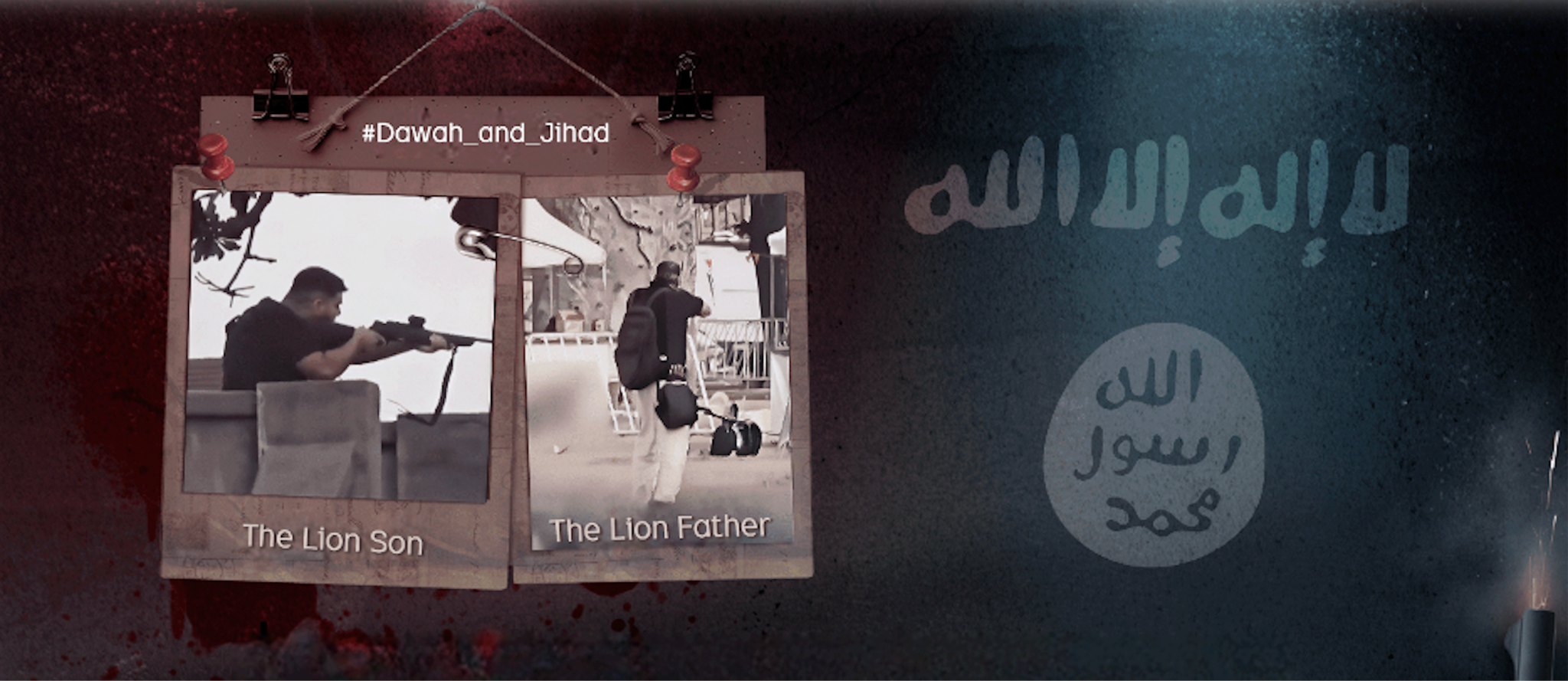
Since December 2025, the Islamic State (IS), its Khurasan affiliate (ISKP), and aligned pro-IS media outlets have been waging a coordinated propaganda campaign around the Bondi Beach attack in Sydney, in which a father and son opened fire on a Jewish Hanukkah gathering, killing and wounding approximately 15 people. The campaign repeatedly invokes the Israel-Palestine conflict, framing the attack as retaliation for Israeli actions in Gaza and positioning violence against Jewish civilians in the West as inseparable from the broader struggle over Jerusalem. Across four major publications spanning December 2025 through June 2026, the outlets have moved from an initial celebration of the attack to systematic operational incitement, theological argumentation, and direct calls to replicate attacks against Western targets. Running beneath and alongside the formal publications, and even praise given to the shooters in the IS spokesman’s latest audio address, IS supporter networks have amplified the campaign online, producing unofficial propaganda content, circulating attack footage set to nasheeds, and calling for more media producers to assist prospective attackers. The publications analyzed here are the Islamic State’s al-Naba newspaper (Issues 526 and 527), ISKP’s Khurasan Voice (Issue 48), and the Al-Iman Media Center’s article “Attacks in Australia.” Together, they constitute not a media echo chamber but a division of labor, with each outlet contributing a distinct layer of a unified radicalization architecture.
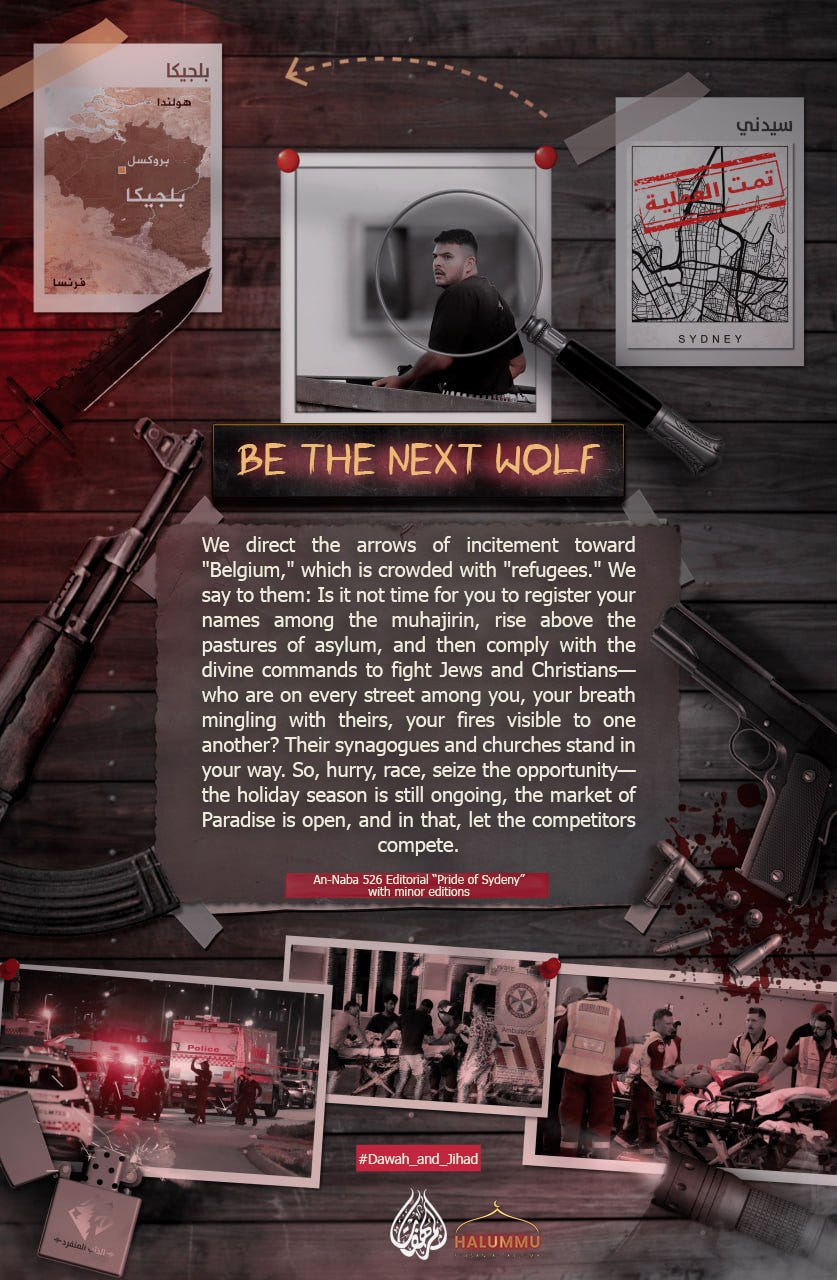
Al-Naba Issues 526 and 527: Celebration, Incitement, and Operational Doctrine
Al-Naba is the Islamic State’s primary Arabic-language weekly newspaper, and its two editorials responding to Bondi, “The Pride of Sydney” in Issue 526 (December 2025) and “The Season of Terror” in Issue 527 (December 2025), represent the backbone of the campaign. Issue 526 arrived within weeks of the attack; Issue 527 followed six months later, timed to another Western holiday season. Read together, they constitute something close to a campaign manual: the first establishes theological and organizational framing, the second converts that framing into explicit operational guidance.
Issue 526 opens not with celebration of Bondi specifically but with a broader declaration about the IS brand and its relationship to attacks it does not formally claim. The editorial preemptively dismisses the criticism that greets every IS-linked operation: that the group is fraudulent, its claims opportunistic, its attackers misguided, by treating such criticism as confirmation of the attackers’ authenticity:
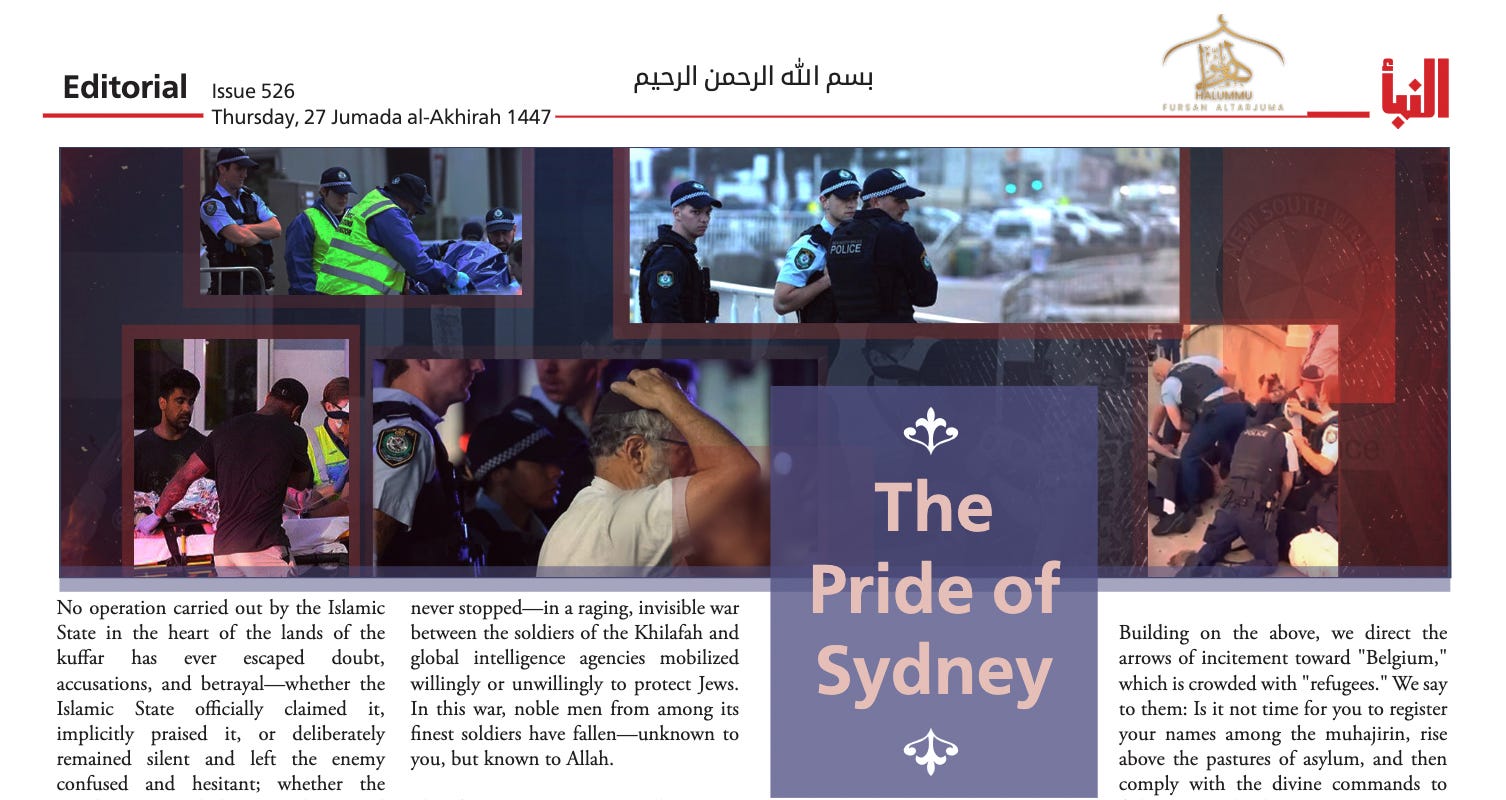
No operation carried out by the Islamic State in the heart of the lands of the kuffar has ever escaped doubt, accusations, and betrayal: whether the Islamic State officially claimed it, implicitly praised it, or deliberately remained silent and left the enemy confused and hesitant; whether the attackers received direct guidance and support or were merely the product of its incitement and methodology; or whether the targets were murtaddin, Crusaders, or even the accursed Jews. All your heroics, O strangers, will never please the rabble and the mob.
The rhetorical move here is deliberate. By folding all possible responses to an attack (claim, implicit praise, silence) into a single coherent IS strategy, the editorial makes the organization’s relationship to any given operation permanently unfalsifiable. It also pre-insulates future attackers against the community disapproval they will inevitably face. The editorial anticipates condemnation and frames it as spiritual noise.
The editorial’s treatment of the Bondi attack itself is brief but pointed. It presents the attack as the direct product of standing IS doctrine, years of consistent instruction to target Jewish and Christian holiday gatherings, and positions the attackers as men who obeyed where others equivocated:
Today, Jews bleed in the streets of Australia after the zealous answered the call and implemented the recommendations to target holidays and gatherings. They armed themselves with the prophetic method and proceeded without turning back, plunging bareheaded into Hanukkah and turning it into mourning. They did not listen to the voices of the rabble among impostors and fools who spared Jewish blood through methods of weakness and dilution.
The phrase “implemented the recommendations” is significant. IS is not claiming credit for directing the attack; it is claiming credit for the doctrine that shaped it. This is a meaningful distinction. It allows the organization to take organizational credit while maintaining plausible distance from operational involvement, and it signals to prospective attackers that inspiration from IS publications is itself sufficient to constitute membership in the IS project. The editorial makes this explicit when it describes IS’s recruitment model as methodical: the organization, it says, “recruits them methodically, fills them with morale, then throws them into the throat of its enemy, bleeding him and striking him fatally, leaving him unable to escape this nightmare.”